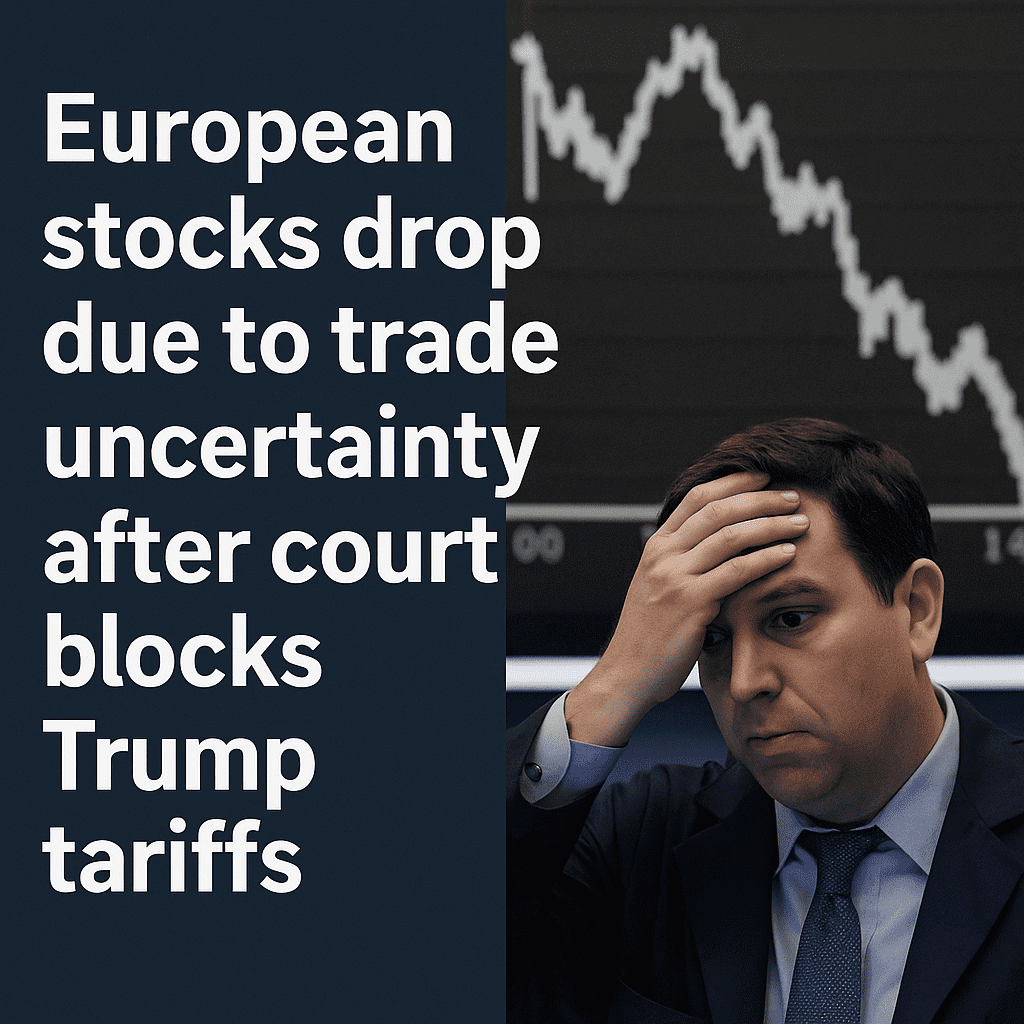
European stocks fell on Thursday, May 29, as the initial relief from the U.S. court’s decision to block some of President Donald Trump’s tariffs lost momentum.
Key Points:
- Market Performance:
- The pan-European STOXX 600 index closed down by 0.19% at 547.88 points.
- The U.S. International Trade Court ruled that Trump overstepped his authority by imposing broad tariffs on imports from the country’s trade partners on April 2.
- Legal Battle:
- In response, the Trump administration filed an appeal and challenged the court’s authority.
- “This does not necessarily mean the tariffs will disappear anytime soon, as the federal appeals court is likely to have a more favorable view of them,” said Lale Akoner, global market analyst at eToro.
- “What this signals is the start of a long legal battle that could reach the Supreme Court, a development with significant implications for the market.”
Ongoing Uncertainty and Market Impact:
- Uncertainty over Tariffs: The continued uncertainty over tariffs led most regional indices to close either flat or in the red on Thursday.
- European Semiconductor Gains: Gains from European semiconductor companies, following Nvidia’s announcement of a 69% rise in quarterly sales, limited the decline in the tech sector, which ended down 0.2%, after hitting its highest level since early March.
- Sector Performance: The utilities sector underperformed its peers, falling by 0.8%.
- Regional Indices:
- London: The Financial Times index fell 0.11%, closing at 8,716.45 points.
- Frankfurt: The DAX dropped 0.44%, ending at 23,933.23 points.
- Paris: The CAC-40 lost 0.11%, closing at 7,779.72 points.
- Milan: The FTSE/MIB index decreased 0.36%, finishing at 39,982.97 points.
- Madrid: The Ibex-35 rose 0.11%, closing at 14,116.60 points.
- Lisbon: The PSI 20 gained 0.20%, ending at 7,375.80 points.
Market Outlook:
- European Stocks Outlook: Despite the ongoing tariff uncertainty, there is an expectation that European stocks will rise slightly through the end of 2025, reaching new peaks in 2026, according to a Reuters survey.