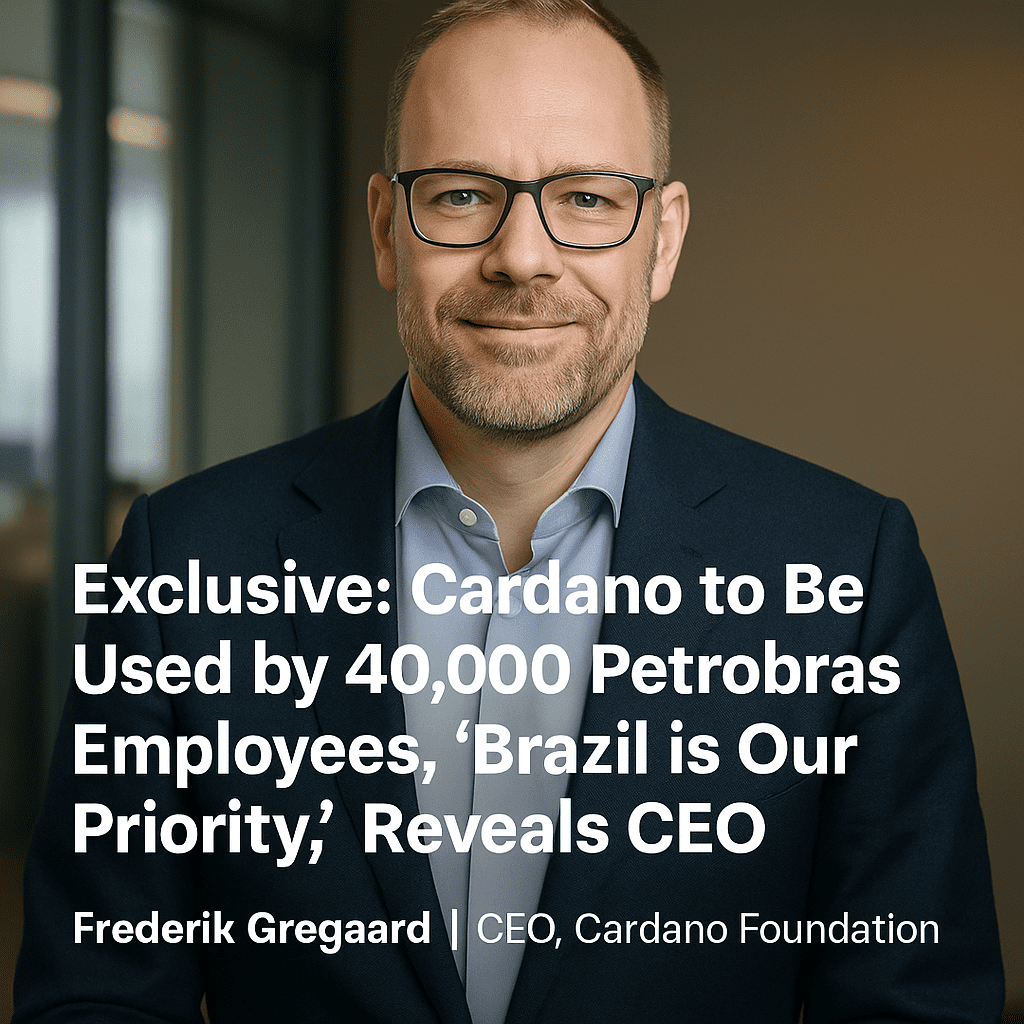
In an exclusive interview with Cointelegraph Brasil, Frederik Gregaard, CEO of Cardano Foundation, highlighted that Brazil is a key priority in Cardano’s expansion strategy.
Key Points:
- Cardano’s Priorities: Gregaard emphasized that Cardano has entered the “Voltaire Era,” marking a new phase of decentralized governance where any ADA holder can participate in the decision-making process.
- Cardano’s Governance Model: The governance follows a tricameral structure, with delegated representatives, stake pool operators, and a constitutional committee ensuring transparency, responsibility, and security in the network.
- Brazil and Cardano: Gregaard revealed that Cardano has formed important partnerships in Brazil, including a collaboration with Petrobras to provide Cardano Academy to 40,000 employees, further strengthening its presence in the region.
Voltaire Era: A New Era of Decentralized Governance
The transition to the Voltaire Era is a key milestone for Cardano, aiming for a truly decentralized governance model. Gregaard explained that the main challenge is not technical, but cultural: shifting from centralized models to decentralized responsibility. The tricameral governance model adopted by Cardano ensures that the collective will of the key participants drives decisions, maintaining the integrity of the ecosystem.
Cardano’s Goal: 1 Billion Users by 2030
Cardano’s roadmap is focused on achieving scalability and interoperability with solutions like Hydra, while also emphasizing developer experience to reduce barriers to entry. The ultimate goal is to reach 1 billion users by 2030.
“By building a robust infrastructure and engaging with regulators, we are laying the groundwork to serve 1 billion users with secure, scalable, and accessible solutions,” said Gregaard.
Strategic Partnerships in Brazil
Cardano has forged strategic partnerships in Brazil, including with SERPRO to promote blockchain adoption in the public sector. In addition to this, Cardano Academy is working with universities like PUC-Rio, UTN Buenos Aires, and the University of Zurich to expand educational access to blockchain technology.
“We aim to show that large-scale adoption is possible, and our partnerships with Petrobras and SERPRO are proof of that potential,” Gregaard stated.
Veridian: Pushing Financial Inclusion
One of Cardano’s flagship initiatives is Veridian, an open-source digital identity platform that provides a path for financial inclusion, especially for the unbanked. Through Veridian, individuals can create verifiable digital identities without needing traditional documents, offering access to basic banking services and improving credit and insurance opportunities.
“We want to enable people to build financial reputations that are recognized across borders, unlocking access to credit and economic mobility,” Gregaard said.
Regulatory Compliance and Decentralization
As global regulatory frameworks evolve, Cardano maintains a proactive and balanced approach. Gregaard highlighted that Cardano works with regulators worldwide, demonstrating that blockchain can enhance transparency and compliance without compromising decentralization.
“Our work with governments proves that technological innovation and regulatory compliance can go hand in hand,” he concluded.